
A couple days ago, I was talking about Pokemon with an old friend from a coffee shop I used to work at. He’s currently playing Shining Pearl, the 2021 remake of the fourth generation (Diamond/Pearl) of Pokemon that originally released in 2006. We were talking about the idea of going back and playing old Pokemon games, which is something I don’t do much anymore except when the rare remake is released — before the Diamond/Pearl remake of late 2021, the previous remake, of Pokemon’s third-gen Ruby/Sapphire (2002), came out in 2014 for the 3DS. Absolutely devastating that that was eight years ago.
I’ve had fruitful conversations about revisiting games with this friend before. Last September, as I was ordering coffee from him, he told me he had embarked on a journey to get three stars on every single Grand Prix in Mario Kart 8 Deluxe on Switch. This included every level of difficulty in the game, from 50cc (easiest) to ‘Mirror Mode’ and 200cc (infuriating). By this spring, he still hadn’t made it past Mirror Mode, so I decided to take up the challenge in his stead. I was living in London for school, but classes were over and I had too much time on my hands. I started three-starring 50cc Grand Prixes in late April, and within a month, I had completed the entire game to perfection. I am, to be sure, unusually skilled at Mario Kart, but I was still hoping this would shame my barista friend into getting back on the grind. I don’t think it worked.
All this is to say, after our most recent talks about Pokemon, I felt ready to embark on an odyssey far deeper and more profound than 100%ing Mario Kart 8 Deluxe (a game I don’t even like that much to begin with).
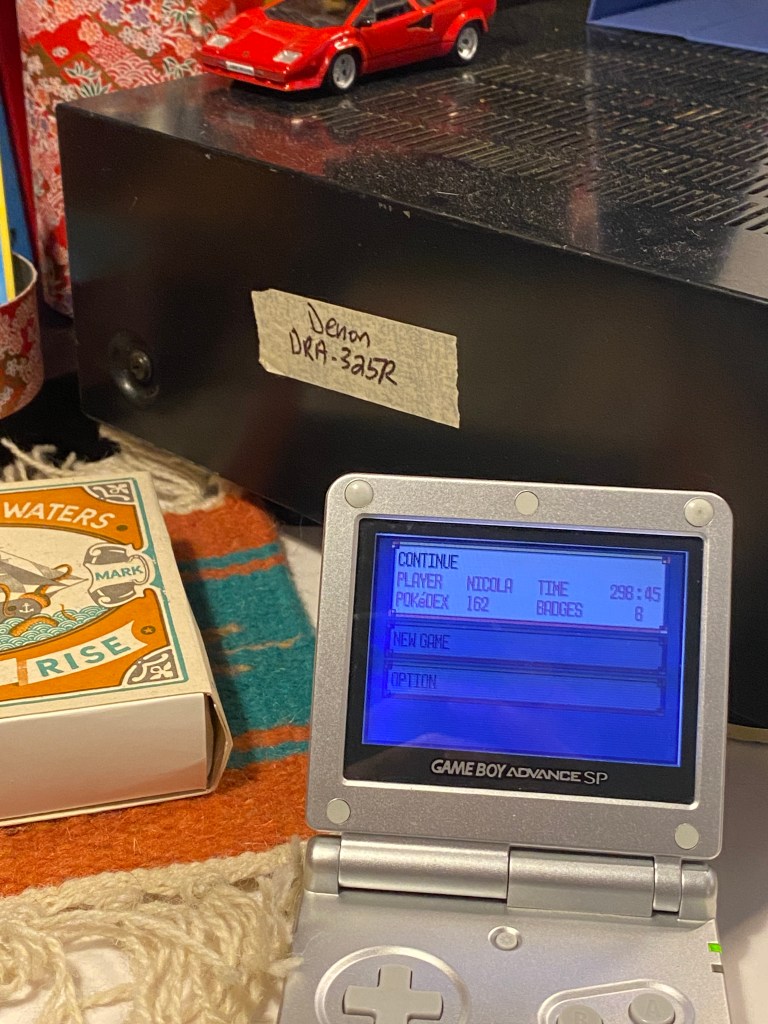
I was born in 1995, and did not own a video game console of any type until my mom bought me a Game Boy Advance SP, along with Pokemon Sapphire, for Christmas of 2003. The SP (pictured below) was a mid-generation refresh of the Nintendo handheld console the Game Boy Advance (or GBA); the SP was also the first Nintendo handheld released in the US to feature a back-lit screen. Looking back, I truly don’t understand how anyone played on the previous handhelds without a backlight–you can turn off the backlight on the SP, and the entire screen becomes almost perfectly occluded.
Sapphire is the first video game I truly loved. This makes it a significant milestone; in addition to have played 10s of thousands of hours of video games across my lifetime, I’ve also written both my college application essay (for the Common App to attend the University of Chicago) and my graduate school personal statement (for Columbia University) on video games. For UChi, I wrote about my experience playing Minecraft and attending the very first MineCon (Minecraft convention) at the Mandalay Bay in Las Vegas in 2011. For Columbia, I wrote about the representation of history and geopolitics in the grand strategy game Europa Universalis IV.
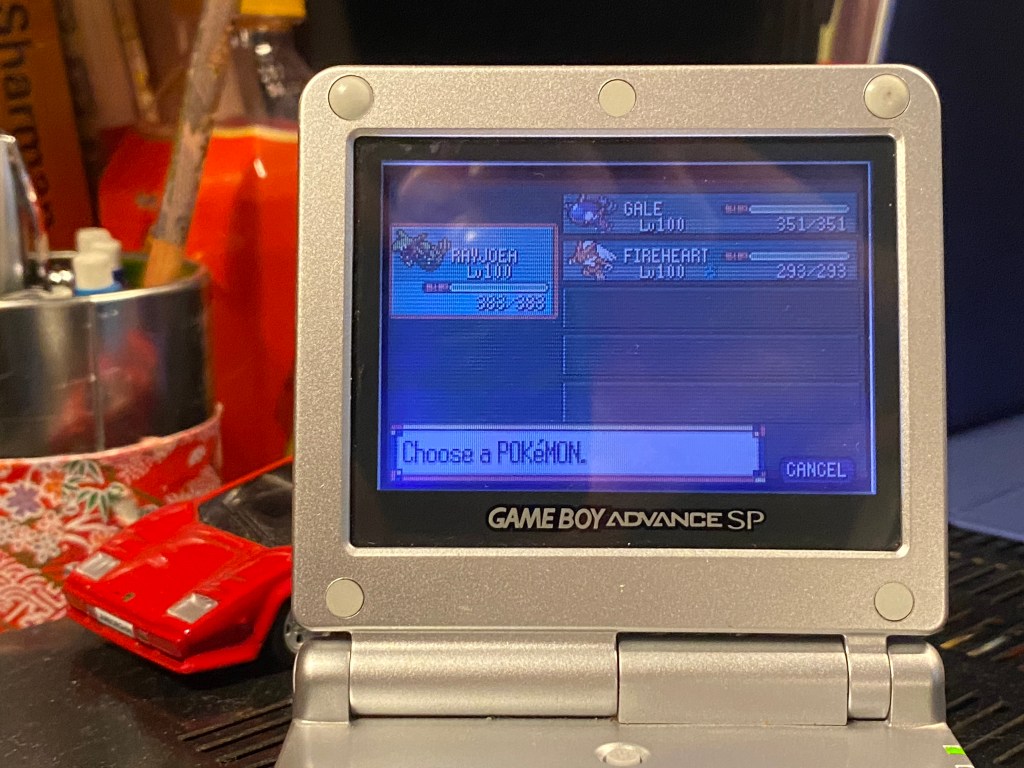
So Sapphire started it all. After a couple noncommital starts in my early days of ownership, I began what would become the odyssey of the save file I still have today. At nearly 300 hours played on this file alone (not to mention on its counterparts Ruby and later Emerald), it may still be in my top 10 most played games of all time, even though I mostly played the game as a young kid when video game time was limited. Below, you can see the final three members of my iconic team. These names, and particularly ‘RAYJOEA,” were well-known to all my friends.
After Sapphire, I played its counterpart Ruby, and then the GameCube’s Pokemon Colosseum (2003), the experimental TV-console offshoot of the main handheld Pokemon series. At that point, I still had not played any game from the two generations that preceded Ruby/Sapphire: Red/Blue (1996) for the original Game Boy, or Silver/Gold (1999) for the Game Boy Color.
But in 2004, Nintendo released an updated version (called a ‘remake’ in Pokemon lingo) of the original games, for the Game Boy Advance. These games were FireRed and LeafGreen. I got FireRed because I thought that the Pokemon ‘Grass-type’ to which LeafGreen referenced was lame, but ironically, I chose the Grass-type starter Pokemon Bulbasaur in FireRed anyway.
Thanks to a combination of original games and remakes (like FireRed‘s second-gen successor HeartGold), I’ve now played every generation of main-line Pokemon games from first-gen all the way to the most recent, Pokemon Sword (2019) for the Switch. I’ve also played Pokemon Blue (the original first-gen copy) on Game Boy Color, making the OG Silver/Gold the only main-line games I haven’t played in original form. This is all probably a bit difficult to keep track of if you haven’t played a lot of pokemon games. Wikipedia has a chart of all the main-line games that is very easy to read, unlike the the screens of any of the SP’s predecessors.
This is all an exceptionally long-winded way of saying, I have decided to play through the entire main line of Pokemon games starting with the first generation. For simplicity and their quality-of-life benefits, I’ll be playing the remakes of at least the first two generations, rather than the original titles. I’ve already begun playing FireRed, and you can see a hint of my progress pictured below. Next time, I’ll write about my journey in that game so far. Welcome to my journey through the generations of Pokemon!


 midnightstatic