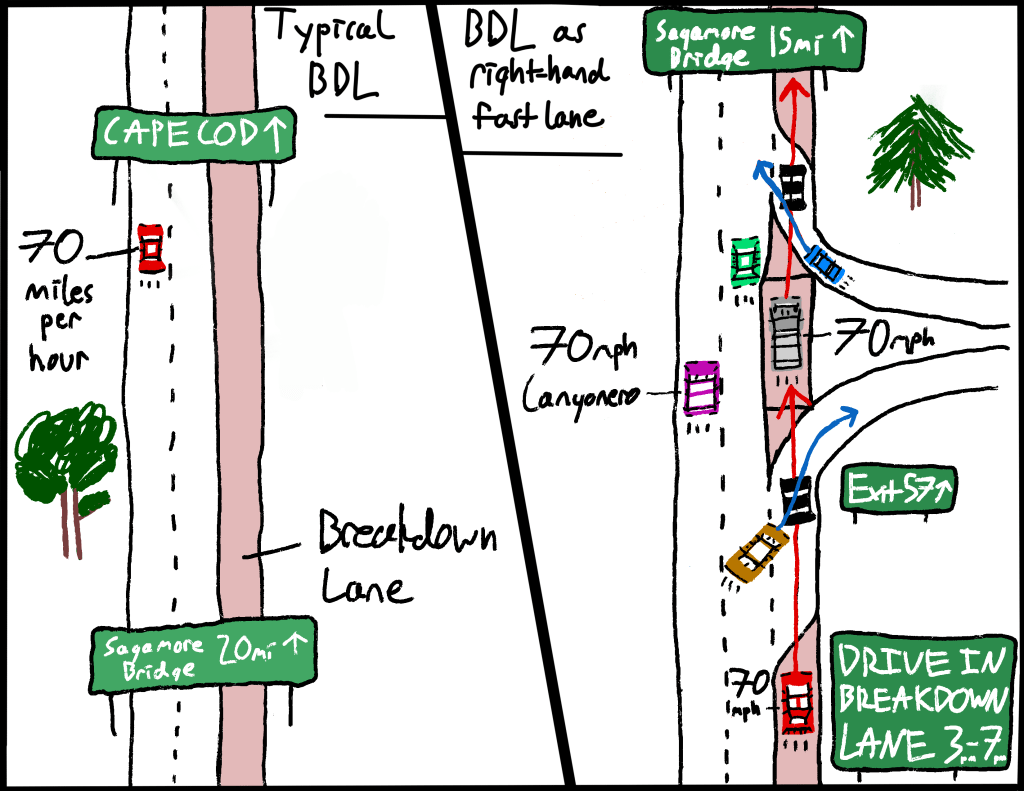

Travel in the right-hand breakdown lane is for some reason permitted on Massachusetts Route 3 between Boston and Cape Cod between the weekday hours of 3pm and 7pm. Earlier today, I happened to be driving through this portion of the route just as the appointed hour struck, and I bore immediate witness to the tragedy of the commons wrought upon our progress.
I would say this is why we can’t have nice things, but the entire purpose of this essay is to argue why travel in the BDL is the opposite of a nice thing anyway.
Encouraging travel in the breakdown lane seems to me as spiritually analogous to posting a sign by the highway stating permission to travel in the oncoming traffic lanes if there aren’t that many cars coming toward you. Which is to say, I’m sure there are some drivers out there who are smart enough to drive headfirst into light oncoming traffic and do just fine — imagine how much more efficient that would be than sitting in bumper-to-bumper on your own side of the road, and plus, you could look oncoming drivers dead in the eye while you lay on your horn and the expletives ?? — but otherwise the idea is poorly founded.
So why do they (who’s they, here?) allow travel in the breakdown lane on Massachusetts Route 3? Surely not because adding another lane reduces traffic?
I have a much better sense for why not to ever allow this and for why the person responsible for this decision should be perpetually banned from the planning and execution of infrastructure.
Obviously, one reason to ban travel in the breakdown lane is that it is a breakdown lane — that is, a lane in which there is a general sociocultural expectation that one’s vehicle breaks down. There are already enough incidents of drivers illegally traveling in breakdown lanes and, at highway speeds, encountering stationary vehicles and other objects parked legally and fairly in that space.
As an aside; this is why you should never stop even in a true breakdown lane — it’s much safer to roll your car into a ditch (or, preferably, pull off the highway entirely) than to park in this autophilic liminal space. Nothing good ever happens in breakdown lanes. And that’s when they’re legitimate breakdown lanes.
So when legitimacy is removed for a short period of certain days of the week, does your outlook as an occupant of the breakdown lane — stationary or projectile — improve? No, although perhaps Darwin’s law improves in efficiency specifically for the drivers who have elected to travel in that lane.
But these individuals unfortunately do not exist in a vacuum. As you may know, highways have ramps via which regular drivers ingress and egress. Usually, these ramps connect to the highway via a short, dedicated lane on the right-hand side into which drivers pull and slow down as they prepare to emerge from their high-velocity night terror.
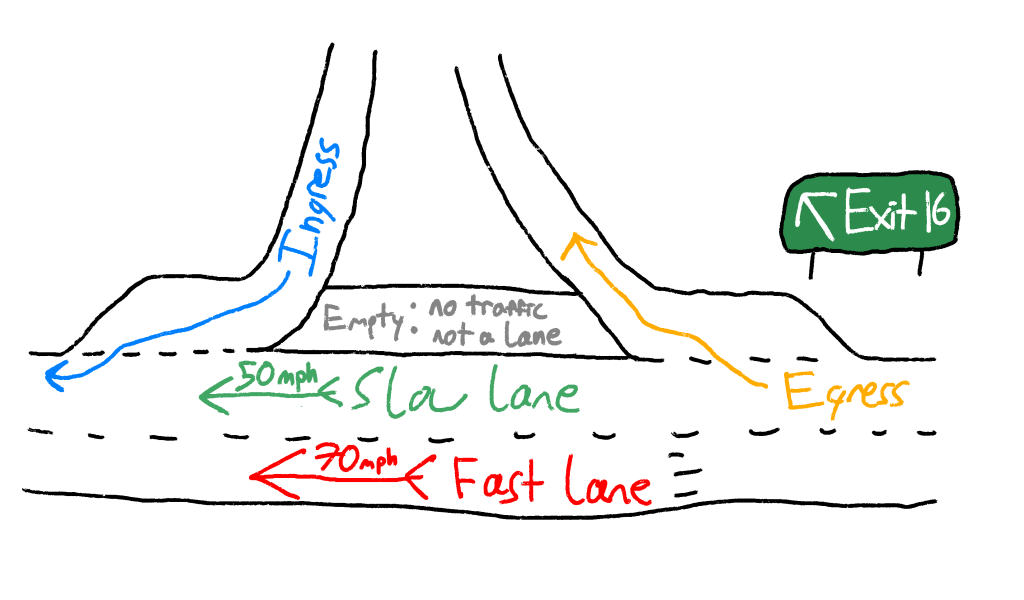
But ho; when there is travel in the breakdown lane, it is at this point when the night terror truly begins.
But before that — the first issue is that the newly open right-hand breakdown lane does not become the de facto slow lane. This is because people who are cautious enough to choose the slow lane are probably also cautious enough to not drive in the breakdown lane.
This means that the slow lane, which is also typically the lane from which egression from the highway begins before moving into the dedicated exit lane, is now surrounded on both sides by fast lanes: on the left, the standard fast lane; and on the right, the lane for the kind of people who immediately swerve into the breakdown lane when the government tells them it’s okay.
Then, the magic happens. At the approach of a highway exit, the right-hand fast lane (for repudiators of the Social Contract) suddenly and unceremoniously becomes the dedicated outlet into which slow-lane (that is, center-lane) drivers merge while rapidly braking in order to safely remove themselves from the highway.
In the blink of an eye: the venue for the precipitously decelerating, and the venue for society’s biggest degenerates — traveling, as they are, by choice at least 10 miles per hour above the speed limit in the right-hand breakdown lane — become one.
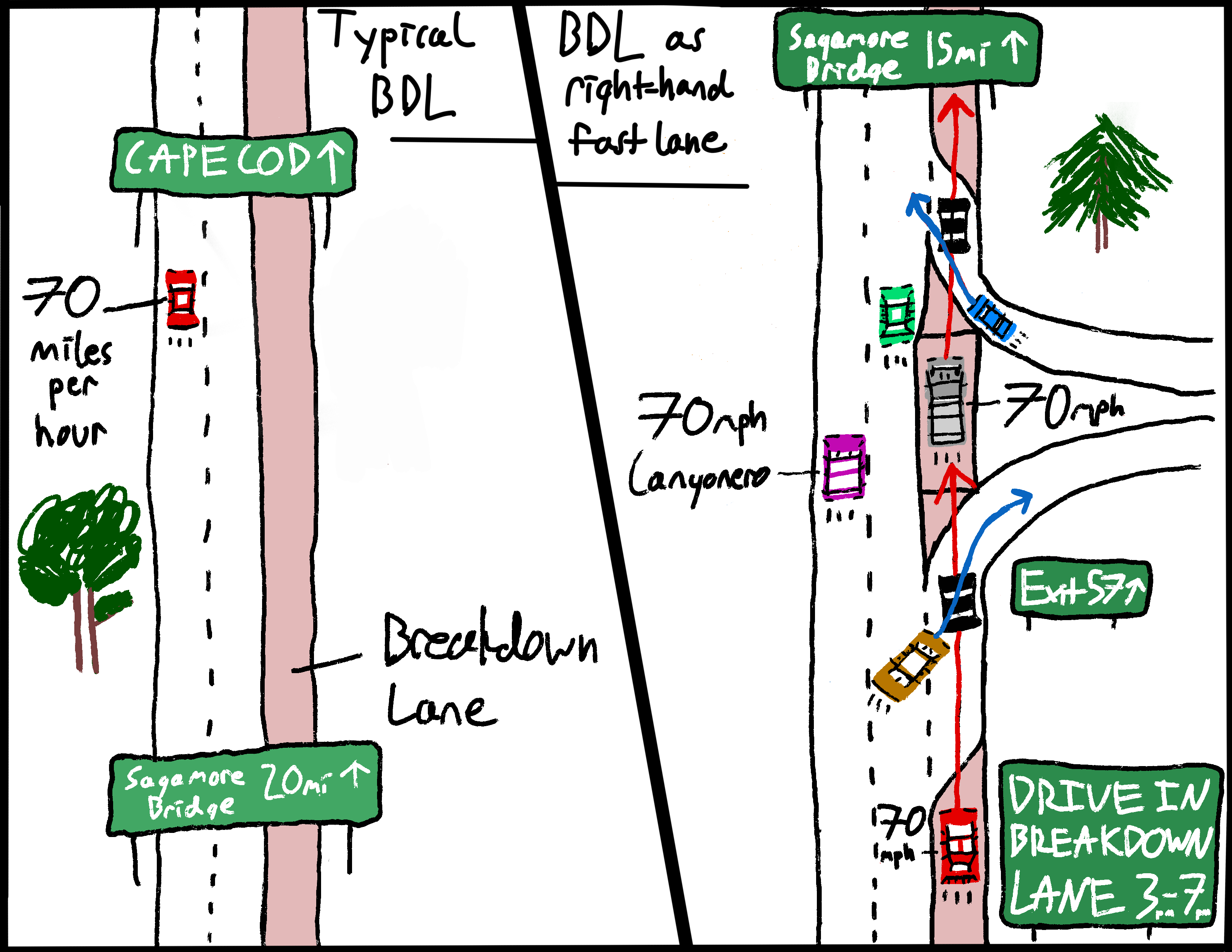
This is not reasonable policy. Please review the illustration below for details.